The Sweet Success: How a Farmers Cooperative in Bukidnon Turned the Sugarcane Industry on Its Head

PLANTING sugarcane is a fickle, high-risk endeavor. Aside from being climate-sensitive and labor-intensive, it’s also long-cycle and heavily influenced by market volatility.
So, those who grew in the industry know that, in the sugar industry, timing is everything. Planters pour money into land preparation, fertilizers, seed canes, and manpower. You need deep pockets to survive while you wait months to harvest.
And for years, the planters of the United Sugarcane Farmers Association simply waited for their luck to change. But no hope was on the horizon.
Gemma Rhay Agbu still remembers the year everything fell apart.
It was 2015. The association, where she would soon take over as manager, was drowning in bad debt. Forty percent of its payables were in default. Members were leaving in droves. The old manager had retired. And the planters who stayed had stopped believing that the cooperative could ever change their lives.
“The association was not really structured to handle money well,” Ms. Agbu recalled. “We had good intentions. But good intentions alone did not pay back loans.”
The association started in 2003 with the original purpose of keeping the peace between the sugar mills and the planters. It was not built for finance. But the cyclical issues keep rearing their ugly heads—planters needed cash for fertilizer, labor, and planting materials. The association started lending, but without proper systems in place, the debts quickly piled up.
By 2015, the association was bleeding. Forty percent of its payables were in default. Membership was shrinking. The manager had retired. Something had to give.
What happened next should be held up as a roadmap for struggling agricultural cooperatives. For one, Agbu stepped into the management role with a single-minded purpose of instituting reforms. The first priority was liquidity. To stabilize operations, the cooperative set an ambitious initial funding goal of P50 million. They turned to the planters themselves, inviting them to become investors. By offering a 5% return to these "planter-investors," the cooperative raised the capital necessary to begin lending back to the membership at an 8% pass-on rate.
The group also got serious about debt. And within one year, the default rate crashed from 40 percent to just 5 percent.
The woman steering this ship was Ms. Agbu. Of course, she would be the first to tell you that she’s not a visionary. Rather, she describes herself as someone who simply grew tired of watching planters lose ground while the big-pocket millers continue to get rich.
From Association to Cooperative
The next step for the association was to evolve into a cooperative, and her reasons for attempting such an undertaking despite zero knowledge and experience were quite simple—access to even bigger capital.
Transforming an association into a co-op and registering with the Cooperative Development Authority (CDA) is not mere paperwork. It is a complete overhaul of their mindsets. Board members who were used to informal agreements now had to learn compliance and stringent regulations.
“The biggest challenge was shifting the mindset of the board members,” Agbu said. “They were used to the old association way. Now we had to follow CDA rules. That was not easy.”
While the group secured a P10 million loan from Asia United Bank to kickstart growth, the money alone didn’t fix their default rate. Tying the payables to the specific harvest season allowed them to improve collection. They had to prove to the planters that the cooperative was their partner for growth, not simply a lifeline when they had no capital.
"When they saw that we were managing the funds responsibly and providing the services they needed, the culture changed," she said, adding that they negotiated interest rates between 3% and 5% for their funds, ensuring that the 8% monthly rate charged to planters remains competitive while allowing the cooperative to cover its overhead and build its reserves.
Diversification as Survival
Sugarcane is often called a "rich man’s crop" because of the high barrier to entry.
For instance, Ms. Agbu said that preparing a single hectare—from breaking the ground to the final harvest—costs approximately P250,000. While the return on investment can reach 20,000 pesos per hectare in the first year, the crop’s rhythmic nature creates extended periods of "dead season" where income depletes, but expenses remain.
She knew that they couldn’t rely on the sugarcane harvest alone. So, USFACO embarked on an aggressive diversification plan. For instance, it invested in a refueling station after realizing that 90% of its customers are farmers who require diesel for tractors and hauling. The cooperative now sells an average of 130,000 liters per week, which ensures a steady cash flow and keeps their 42 regular personnel employed year-round, even when the mills are silent.
The cooperative also hires seasonal workers on a rotation basis to help as many families as they can. "The sugar industry is seasonal, but the needs of families are not," Ms. Agbu emphasized.
Also, the cooperative took out a P40 million loan, which it used to expand into logistics. Most of the funding went into buying 15-20 ton dump trucks and lending them to planters.
The cooperative also earns a 1% share of the total milled sugarcane delivered by members to the BUSCO Sugar Milling Company Inc. in Quezon town and Crystal Sugar Milling Company in Poblacion Maramag town, both in Bukidnon. Its share comes in the form of raw sugar certificates, which USFACO converts to cash.
But the real profit comes from trading. When sugar prices are favorable, USFACO works with outside traders to move product. The farm gate price might be P2,175 pesos for each 50-kilo bag. But the cooperative can repack that same bag for roughly P65 pesos per kilo, earning roughly P3,250 pesos per bag in the process. The differential—about 1,000 pesos per bag—goes back to the cooperative.
“That differential covers our labor, our logistics, our risk,” Agbu said. “Without it, we would just be passing money from one hand to the other.”
Diversification expanded exponentially. Pretty soon, the cooperative has dipped its fingers in truck loans, fertilizer financing, and a sugar repacking project. And it is now preparing to venture into oil palm in North Cotabato after scoping some fertile land there. The intention has been clear from the start: its income must never again depend on a single harvest season.
“We can harvest palm oil every 15 days,” she said. “There is no off-season. If we integrate oil palm cultivation, our people can work all year.”
The Value of Digitizing and Networking
The USFACO of today looks unrecognizable from the association of 2003. For instance, it is currently in the middle of a digital transformation, replacing manual ledgers with accounting and production software. This transparency is vital for survival since they are now managing nearly P200 million in exposure and an equal amount in payables.
Their reach has also gone international. For instance, it has ventured into value-added production through a repacking facility project funded by the European Union, with plans of supplying customized sachets to community stores, restaurants, and even hotels.
Also, its engagement with the Federation of Peoples' Sustainable Development Cooperative (FPSDC) opened new doors for USFACO to learn best practices it could adopt for its operations.
"Exposure to international best practices, like our farm tour to Spain, opened our eyes to what is possible," said Ms. Agbu. "We aren't just farmers contained in our own ecosystem; we are part of a global value chain."
Despite its success, the cooperative never lost sight of its role in the community. Its scholarship program, dating back to 2003, continues to be a cornerstone of its social mission. Fifteen scholars have been supported so far. Most are children of the harvesters.
“We cannot change the whole industry overnight,” Ms. Agbu said. “But we can send a few kids to school.”
The Road Ahead
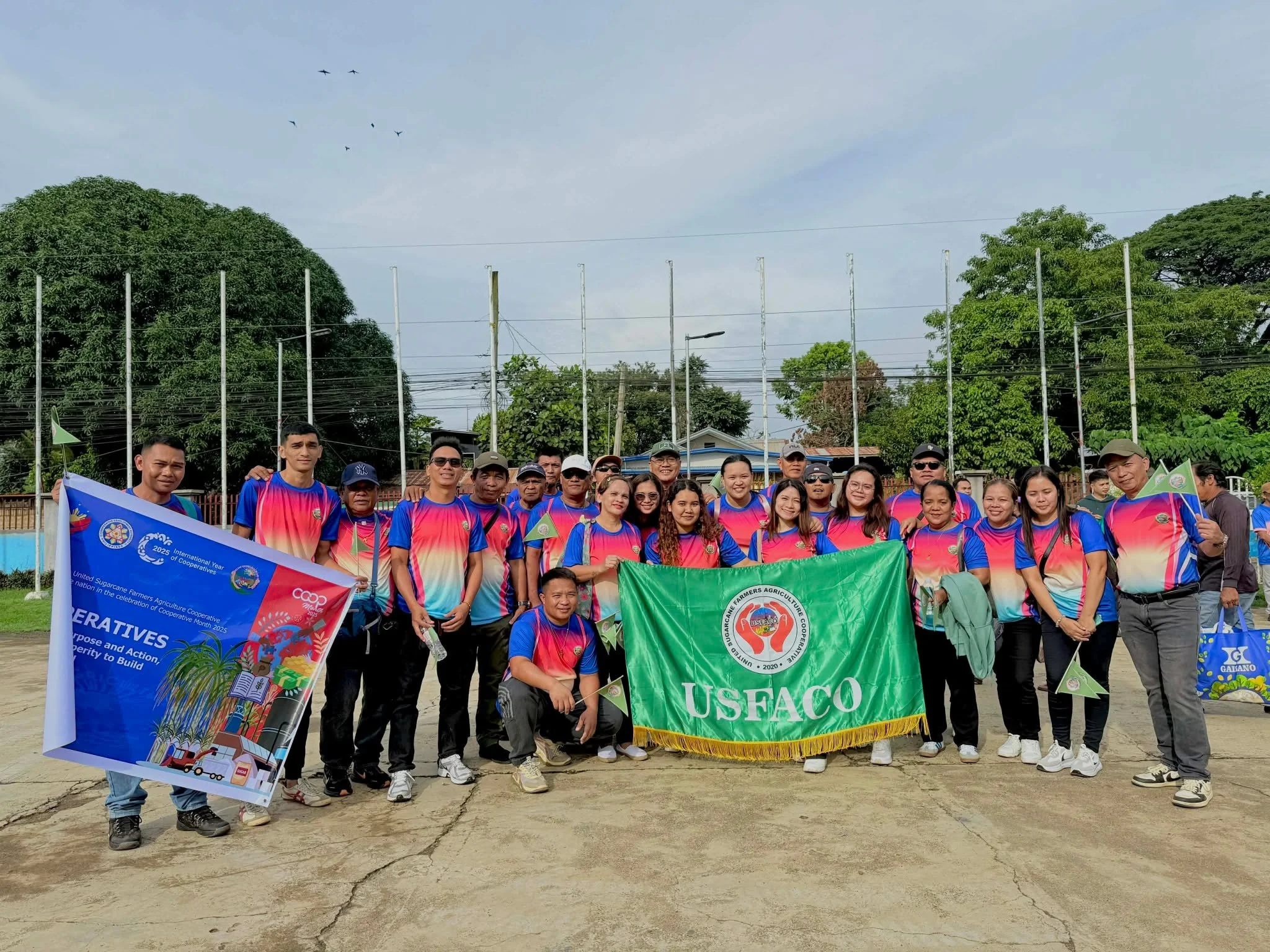
USFACO is now classified as a “large” cooperative in terms of assets. It has a 100-hectare cooperative farm, bought an eight-hectare property in Busco for P4 million, and paid for it with a fully settled P15-million loan from Land Bank. She said that the property is earmarked for future commercial use.
But the cooperative is not slowing down despite its success. In fact, it’s starting to roll out a three-year plan for full diversification.
Agbu doesn’t pretend that USFACO’s journey was smooth. The transition from association to cooperative was particularly painful, and, admittedly, there was a lot of pushback from management to members. Board members had to learn compliance. Planters had to accept stricter repayment terms. The cooperative had to build credit from scratch.
However, she credited their success to their willingness to change their mindset and the humility to recognize they don’t know everything. And, of course, the trust of their members. "A cooperative is only as strong as the trust of its members,” she said.